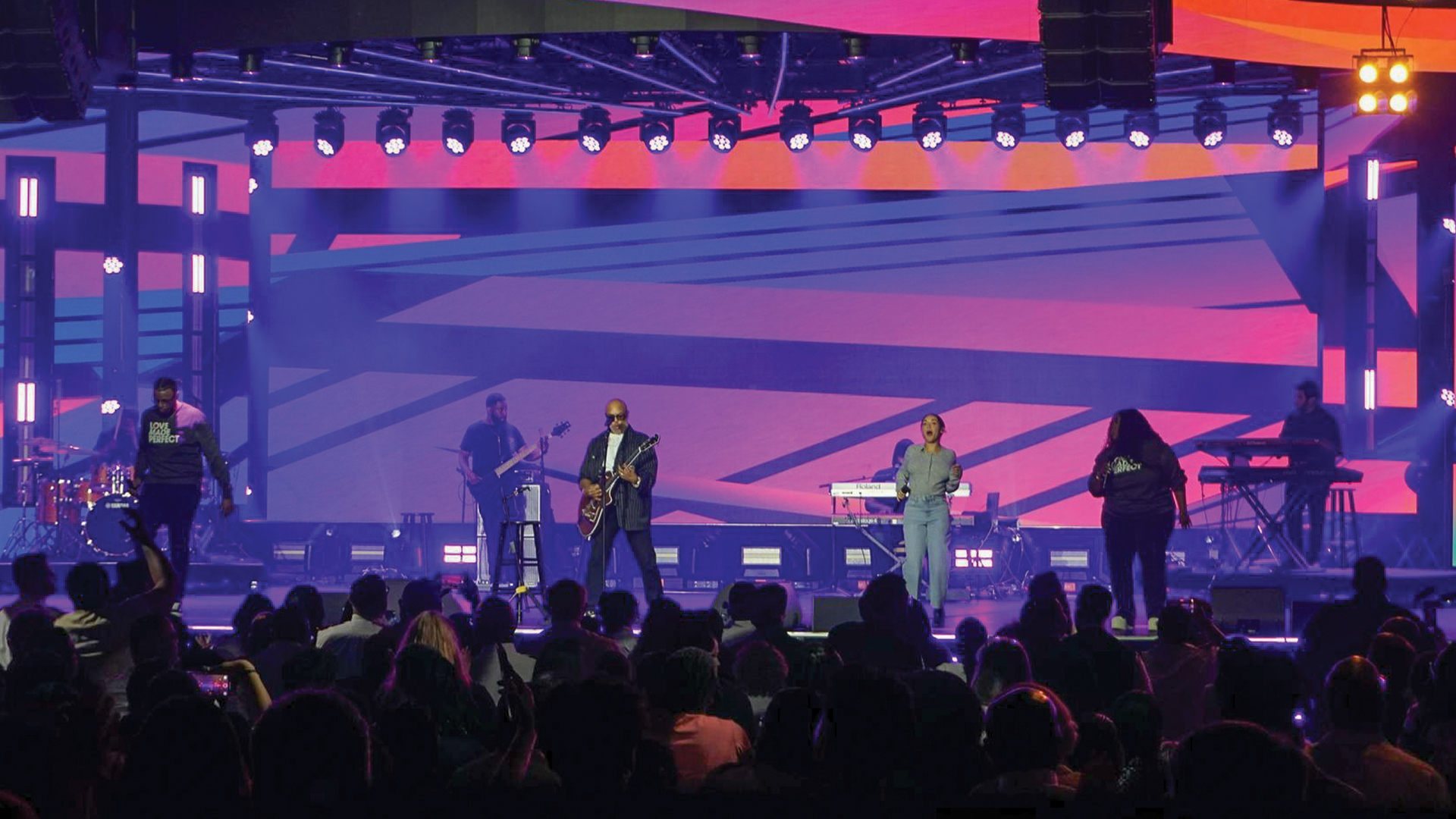
A corporate event that deploys its LED wall content across ten simultaneous locations—three indoor ballrooms in New York, two outdoor corporate campus events in Silicon Valley, two conference centers in London, and three arena-scale events in Singapore—confronts a content scaling challenge that is simultaneously technical and creative. The technical challenge: the same content assets must perform adequately on display systems ranging from a 200-pixel-wide 2.6mm indoor LED panel in a hotel ballroom to a 30-metre outdoor festival wall in direct sunlight at 5,000 nits. The creative challenge: the brand identity the content expresses must be consistent across locations whose ambient conditions, audience characteristics, and viewing geometries differ radically.
This multi-location content scaling brief—increasingly common among global brands that run simultaneous multi-city event campaigns—is the commercial context where the production companies with the deepest content engineering expertise separate themselves from those whose design capability exceeds their technical execution capability.
Brightness and Contrast: The Indoor-Outdoor Divide
The most dramatic technical difference between indoor and outdoor LED wall deployments is the brightness required to achieve equivalent visual impact against different ambient light conditions. An indoor ballroom LED wall operating at 600 nits produces a visually compelling image against the controlled lighting environment of a corporate event space. The same content on the same wall in direct afternoon sunlight at an outdoor location requires 3,000–5,000 nits to achieve equivalent perceived contrast against the 1,000+ lux ambient light level—a brightness requirement that fundamentally different hardware and content design approaches must serve.
Content designed for indoor deployment at 600 nits will appear washed out and low-contrast when viewed outdoors in sunlight at the same operating brightness—a limitation that is not a calibration failure but a physics reality. The contrast compression that high ambient light imposes on LED display content changes the effective visual dynamic range available to the content designer from the 1,000:1 ratio available in a controlled indoor environment to the 10:1 ratio that 5,000 nit output against 500 lux ambient light provides.
Content adaptation for outdoor deployment involves specific design adjustments that compensate for contrast compression: increased color saturation (to maintain perceived color differentiation against a washed-out environment), reduced shadow detail (which disappears in compressed contrast), and higher motion energy (which compensates for reduced static image quality with temporal dynamism that the viewer’s attention follows). These adaptations are documented practices that experienced content designers apply systematically when adapting indoor content for outdoor use.
Pixel Pitch Adaptation and Content Resolution Strategy
Multi-location LED deployments that include both intimate indoor environments and large outdoor environments will inevitably use different pixel pitch panels at different locations—not from inconsistency but from rational matching of display specifications to viewing distances. An event specifying a 1.9mm pitch indoor wall for a 500-person ballroom and a 6mm pitch outdoor wall for a campus event is making sensible engineering decisions; the content scaling challenge is ensuring that the same content brief produces appropriate visual results on both displays.
Content resolution strategy for multi-pitch deployments requires the content designer to work in a resolution that can be downsampled efficiently to both display resolutions. A 4K content master (3,840 × 2,160 pixels) provides sufficient resolution for the high-pixel-density indoor display while downsampling efficiently to the lower effective pixel count of the outdoor display. Content elements that rely on fine detail—typography, intricate graphic patterns, photographic content with small-scale texture—require evaluation at both display resolutions to ensure they remain legible at the outdoor display’s lower effective resolution.
The Disguise media server platform manages multi-location content delivery through its multi-output architecture that can simultaneously drive displays at different resolutions with content adapted for each display’s characteristics. Productions running simultaneous indoor and outdoor displays from a unified Disguise session—connected through the event’s network infrastructure—can apply per-display color correction, brightness adjustment, and content scaling parameters within the Disguise environment without requiring separate content versions for each display type.
Brand Consistency Across 10 Simultaneous Locations
For global brand event campaigns deploying LED wall content across 10+ simultaneous locations, brand color consistency is the quality metric that the marketing team enforces and that the production team must achieve across a technical supply chain—LED panels, processors, content servers—that introduces color variation at every link.
The color pipeline management approach that achieves brand consistency across multi-location deployments requires three elements: first, a master color reference—the exact CIEXYZ or Pantone specification of each brand color, provided by the brand’s visual identity team and used as the calibration target for every display in the campaign; second, Brompton Tessera processing or equivalent per-panel calibration at each location that brings every display to the master color reference; third, content-to-processor workflow documentation that specifies the exact color space transformations applied between the content creation software, the media server, and the LED processor at each location.
The human verification step that technology cannot replace: a brand representative viewing a calibrated reference sample of the brand’s colors on each display and confirming that the visual result matches the reference before the event opens. This human verification catches the systematic errors that calibration processes miss—the processor that was calibrated correctly but whose settings were overwritten by a local technician’s adjustment, the content file that was exported in the wrong color profile. Technology provides the capability for brand consistency; human verification confirms its achievement.
Operational Scaling: Managing 10 Simultaneous Locations
The operational scaling challenge of managing 10 simultaneous LED wall deployments—each with its own production team, its own technical challenges, and its own event schedule—requires a production management architecture that the production company must build before the event campaign begins rather than improvising during its execution.
Centralized content management with local execution is the operational model that most successfully balances creative control (maintaining consistent visual output across all locations) with operational flexibility (allowing each location’s production team to respond to site-specific conditions). The content master is maintained centrally—updated, versioned, and distributed from the production company’s central content management server—while each location’s Disguise or Resolume operator has the ability to apply local adjustments within defined parameters: brightness range, content playback timing, emergency content substitution.
The communication infrastructure supporting 10 simultaneous locations requires production management tooling beyond the standard touring production’s scope. Zoom or Teams production calls across time zones, shared project management platforms (Notion, Asana) for cross-location task tracking, and real-time monitoring dashboards that show each location’s LED wall system status to the central production manager—these are the operational infrastructure investments that multi-location campaign production requires and that production companies building capability in this market must invest in explicitly rather than improvising with generic communication tools.
